
What Is the Best Month for Whale Watching in Andenes?
There isn't a documented "best" month for actually seeing whales on an Andenes safari. Sperm whales live near the Bleik Canyon and are encountered consistently from May through September; the only study to look closely at their seasonal patterns found stable, long-term residency across the whole season rather than a single peak month. What does change from month to month is the weather, the daylight, and how busy the harbor is — and those differences are large enough to genuinely affect which month is right for your trip. This article breaks down May through September by what actually varies, not by whale sightings, since the evidence doesn't support ranking months on that basis.
Quick answer:
- No month has meaningfully better whale-sighting odds — sperm whales are present near Andenes throughout the May–September season
- Midnight sun runs from roughly May 22 to July 21
- July is the warmest and calmest month for weather, but also the busiest and most expensive, due to the Norwegian summer holiday
- August has similar mild weather to July with noticeably lighter crowds
- May is the quietest and cheapest month but also the coolest; September is quiet but the wettest month by far
Is there a peak month for sperm whale sightings?
Not based on the evidence available. Sperm whales at the Bleik Canyon are largely resident rather than migratory during the summer season, and a 2025 study in Marine Mammal Science that tracked individually identified whales over 15 years found average stays of around 18 days per whale during the May–September period, with no single month standing out as a sighting peak. Encounters are considered likely throughout the summer season, rather than concentrated in one particular month.
That means the choice of month comes down to what you'd actually experience on land and at sea — weather, daylight, and crowds — rather than your odds of seeing a whale.
Andenes month by month
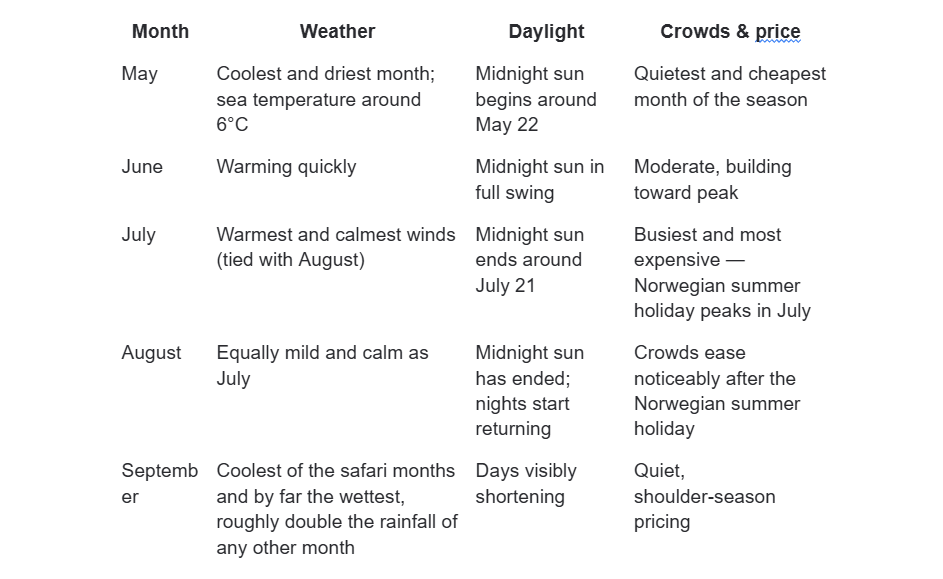
May. The safari season opens with the coolest, driest conditions of the summer and the lowest crowds and prices. Midnight sun begins around May 22, so the back half of the month already has round-the-clock daylight.
June. Weather warms steadily and midnight sun is in full effect for the entire month, giving round-the-clock daylight for the whole trip window. Crowds are moderate — busier than May, but well short of the July peak.
July. The warmest month, tied with August for the calmest winds, but also the busiest and most expensive time to visit, since it overlaps with the Norwegian summer holiday (fellesferie), which peaks nationally in mid-to-late July. Midnight sun ends around July 21, so early July still has 24-hour daylight while late July starts seeing a proper sunset again. Booking ahead matters more in July than in any other month.
August. Weather stays just as mild and calm as July, but crowds thin out noticeably once the Norwegian summer holiday ends. Midnight sun is over, so you'll see a sunset again, but days are still long. For travelers optimizing for good weather without July's crowds, August is generally the strongest month.
September. The quietest and cheapest month left in the season, but also the wettest by a clear margin — roughly double the rainfall of May through August — and winds pick back up. Days are noticeably shorter than midsummer. It suits travelers prioritizing low prices and few other visitors over predictable weather.
When is the midnight sun in Andenes?
Andenes sits far enough north (around 69°N) that the sun doesn't set at all for a stretch of the summer. Visit Norway puts the midnight sun period for this part of Vesterålen at roughly May 22 to July 21. Inside that window, a whale safari runs in full daylight regardless of departure time — practically, this doesn't change your odds of seeing whales, but it does mean there's no "golden hour" or dusk light for photos, since the sun stays high rather than setting.
So which month should you actually pick?
Since whale sightings are consistently likely all season, the decision is really about what you want from the rest of the trip:
- Best balance of mild weather and lighter crowds: August
- Midnight sun with the fullest daylight window: June or July
- Lowest prices and quietest harbor, if you don't mind cooler weather: May
- Midnight sun without July's peak crowds: June
- Shoulder-season quiet and lower prices, if you can tolerate rain: September
How to plan around Andenes' weather
- Pack warm, wind- and waterproof layers regardless of which month you book — conditions can shift quickly at sea even in July and August.
- If you want to avoid the busiest, priciest window, book May, June, or August rather than July.
- If seeing the midnight sun matters to you, travel between late May and mid-July and check the exact dates for your travel year, since they shift slightly year to year.
- If you're booking September, build some flexibility into your itinerary in case of weather-related rescheduling, since it's the wettest month of the season.
For more detail on what to expect and how to pack, see our travel planning guide, or read the full rundown of the Andenes whale safari itself. If you're still deciding between Andenes and Arctic Whale Tours' other regions, our guide to where to go whale watching in Northern Norway compares them by season and species.
Frequently asked questions about the best month for whale watching in Andenes
Is there a peak month for sperm whale sightings in Andenes? Not based on current research. Sperm whales are resident near the Bleik Canyon throughout the May–September safari season, and sightings are described as consistently likely across the whole period rather than concentrated in one month.
What is the best month for weather in Andenes? July and August are the warmest and calmest months, with similar conditions. July is also the busiest and most expensive month, so August often offers a better balance of good weather and lighter crowds.
When can you see the midnight sun in Andenes? Roughly from May 22 to July 21, based on Visit Norway's figures for this part of Vesterålen. A safari during this window runs in full daylight no matter what time it departs.
Is September a bad time for an Andenes whale safari? Not for whale sightings, but it's the wettest and windiest month of the season by a clear margin, and days are noticeably shorter than midsummer. It's a good choice if you want low prices and few other visitors and can tolerate more variable weather.
Is July too crowded for a whale safari in Andenes? It's the busiest and most expensive month, since it overlaps with the Norwegian summer holiday. It's still a good month for the safari itself, but booking well in advance matters more than in other months, and August offers similar weather with lighter crowds.
Join Us on the Water
Whether you're traveling as a couple, family, or solo adventurer— We’re ready to welcome you aboard.

.svg)
.svg)
