
Where Is the Best Place for Whale Watching in Northern Norway?
The best place for whale watching in Northern Norway depends on two things: when you are traveling, and which whales you want to see. Sperm whales are found close to Andenes and Stø in Vesterålen for most of the year, thanks to a deep-sea canyon right off the coast. Orcas and humpback whales gather in the fjords around Tromsø each winter, following the herring they feed on — and exactly where within that fjord system they concentrate shifts somewhat from year to year. This guide compares the whale-watching regions served by us at Arctic Whale Tours — Andenes, Stø, and Tromsø — by season, species, and trip style, so you can choose the safari that fits your trip.
Quick answer:
- Summer (roughly May–September): Andenes and Stø, for sperm whales
- Winter (roughly November–January): Tromsø, for orcas and humpback whales
- There is no single fixed "best" location — the right one depends on your travel dates and which species you want to see
The best whale-watching regions in Northern Norway at a glance
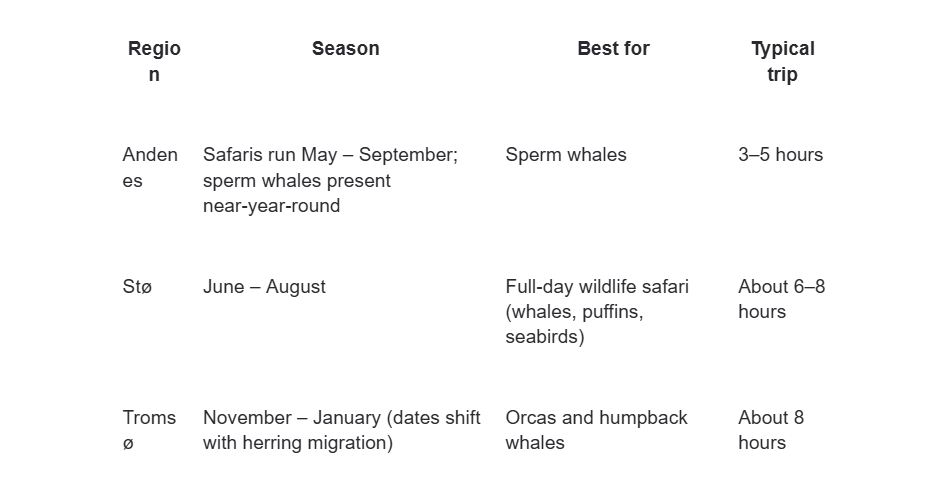
The table below summarizes the three regions covered in this guide.
The winter herring migration that draws whales toward Tromsø also passes through Skjervøy, Lyngen, and Kvænangen further north and east, and exactly where the whales concentrate in a given winter depends on where the herring settle. Further north still, the Altafjord sees similar winter orca and humpback activity. Further south, Lofoten doesn't have a comparable season today: Visit Lofoten's own tourism board states that no operators there currently run dedicated whale-watching safaris, and that a sighting is down to chance rather than something bookable. That's a change from the past — Norway's commercial orca-watching industry actually started in Lofoten and nearby Tysfjord back in 1985, before moving north to Andenes and, later, Tromsø. If your travel dates or home base don't line up with the regions covered here, our broader guide to where to go whale watching in Norway or Visit Norway's national whale watching overview are useful starting points for the rest of the country.
Andenes: one of the few places to see sperm whales for most of the year
Andenes sits at the edge of the Bleik Canyon, a deep-sea trench that runs close to shore. Cold, nutrient-rich water rising out of the canyon draws squid near the surface, and sperm whales feed on that squid within reach of a relatively short boat trip. Because sperm whales are largely resident in this area rather than migratory, they can be encountered near Andenes across most of the year — one of very few places in the world with that kind of year-round reliability. Arctic Whale Tours' public safaris run from May to September, when weather, daylight, and demand make the crossing most practical, but sightings elsewhere in the year are also reported.
Safaris from Andenes run three to five hours, shorter than our Stø and Tromsø trips covered in this guide, since the whales feed relatively close to land here. Sperm whales are the main draw, but humpback whales, orcas, pilot whales, and seabird colonies are also regularly seen on the same trip.
Here you can read more about the Andenes summer whale safari.
Stø: a full-day Arctic wildlife safari built around more than whales
Stø, on the western tip of Vesterålen, takes a different approach. Rather than a short, focused whale trip, safaris from Stø run for about six to eight hours and combine whale watching with visits to seabird cliffs, including puffin colonies, and sightings of seals along the coastline. Sperm whales, orcas, and pilot whales are seen in largely the same waters as the Andenes safaris, but the Stø format is built for travelers who want a complete day on the water rather than the most time-efficient route to a whale sighting.
This makes Stø the better choice when the goal is a broader wildlife experience rather than a quick, targeted safari. Since Andenes and Stø operate in the same general season and share overlapping whale populations, the decision between them is really a decision about pace and scope rather than which region has more whales. For a closer comparison of the two, see our Stø whale safari guide.
Tromsø: orcas and humpback whales during the winter herring migration
From roughly November to January, large schools of herring move into the fjord system north of Tromsø to overwinter, and orcas and humpback whales follow them in. The Tromsø winter safari runs about eight hours, since reaching the feeding grounds and returning takes time even before accounting for time with the whales.
Exactly where within the fjord system the herring — and therefore the whales — concentrate has shifted over the past decade, sometimes closer to Tromsø and sometimes further out toward Skjervøy, Lyngen, or Kvænangen. Arctic Whale Tours' Tromsø safari adjusts its route within that area depending on where the whales currently are, so how far the boat travels can vary somewhat season to season. More detail on the winter safari itself is available on our winter whale safari page.
How to choose the right place for your whale watching trip
With three regions and two very different seasons, most of the decision can be made by answering three questions in order.
- When are you traveling? Roughly May–September points to Andenes or Stø. Roughly November–January points to Tromsø. The seasons don't overlap, so this is usually the deciding factor.
- Which species matter most to you? Sperm whales are the specialty around Andenes and Stø, and are around for most of the year. Orcas and humpback whales are the winter specialty around Tromsø, tied to the herring migration.
- What kind of trip do you want? A short, focused safari (Andenes) suits limited time; a full-day wildlife experience (Stø) suits travelers who want more than whales; the Tromsø winter safari is a longer, dedicated day trip built around reaching the whales wherever they currently are.
Weather, sea conditions, and daylight hours also affect which trips run on a given day, particularly in winter. Our travel planning guide covers what to expect season by season, including clothing, daylight, and how far in advance to book.
About Arctic Whale Tours
Arctic Whale Tours has operated whale safaris in Northern Norway since 2014, running trips from Andenes, Stø, and Tromsø. Our boats are kept small and designed to minimize engine noise around the whales, and trips are guided by staff with marine biology backgrounds. Because whale sightings can never be fully guaranteed, our safaris include a rebooking option: guests who don't see whales on a trip can join another safari at no extra cost.
How to plan your whale watching trip in Northern Norway
- Choose your season first. Decide whether you are traveling roughly May–September (Andenes, Stø) or roughly November–January (Tromsø) — this narrows your options to two regions before anything else.
- Match the region to what you want to see. If sperm whales are the priority, choose Andenes or Stø. If orcas and humpback whales are the priority, choose the Tromsø winter safari.
- Decide on trip length and style. A shorter, focused safari suits travelers with limited time; a full-day trip suits those who want a broader wildlife experience.
- Confirm current conditions before booking. Because winter whale locations shift with the herring migration, check with us close to your travel dates for the latest on where the whales have been.
Frequently asked questions about whale watching in Northern Norway
What is the best time of year for whale watching in Northern Norway? It depends on the species. Sperm whales can be seen near Andenes for most of the year, with public safaris typically running from May to September. Orcas and humpback whales are most active from around November to January around Tromsø, when they follow the herring migration into the fjords.
Is Andenes or Tromsø better for whale watching? They aren't really comparable, since they involve different species and different patterns of presence. Andenes offers sperm whales that are largely resident near the Bleik Canyon and can be seen for most of the year. Tromsø offers orcas and humpback whales that are migratory and only present in winter, following the herring. Which is "better" depends on when you're traveling and which species you want to see.
Can you see orcas and sperm whales on the same trip in Northern Norway? It's uncommon, since the two species follow different patterns. Sperm whales are typically seen near Andenes and Stø for most of the year, while large orca activity is concentrated in winter further north, around Tromsø. Some species, such as humpback and pilot whales, can appear in both regions.
Do you need any special gear for whale watching in the Arctic? Warm, wind- and waterproof layers are recommended year-round, since sea temperatures keep conditions cold even in summer. Winter trips in particular call for proper cold-weather clothing, gloves, and a hat, as safaris often run in near-freezing temperatures.
Plan your Arctic whale watching trip today
Whichever region fits your trip best, Arctic Whale Tours runs safaris from all three regions covered in this guide. Explore the Andenes summer safari, the Stø full-day safari, and the Tromsø winter safari directly, or start with our travel planning guide to match your dates to the right region.
Contact: Andenes — Hamnegata 75, 8480 Andenes — +47 48 15 10 97 Stø & Tromsø — Fiskeværsveien 17, 8438 Stø — +47 47 38 46 21
Join Us on the Water
Whether you're traveling as a couple, family, or solo adventurer— We’re ready to welcome you aboard.

.svg)
.svg)
