
Where Should You Go Whale Watching in Norway?
There's no single "best" place to go whale watching in Norway — the right answer depends on when you're traveling, which species you want to see, and whether you're after a single-day safari or a longer expedition. Vesterålen (Andenes and Stø) and Tromsø cover most travelers' needs on the mainland, Svalbard offers a completely different Arctic species mix further north, and — despite its fame — Lofoten isn't actually a reliable whale-watching destination at all. This guide walks through how to decide, rather than pointing you to one fixed spot.
Quick answer:
- Traveling May–September and want sperm whales: Andenes or Stø in Vesterålen
- Traveling November–January and want orcas and humpback whales: Tromsø and the wider Lyngen/Alta/Kvænangen area
- Want a different Arctic species mix (blue whales, minke whales, beluga) and don't mind a longer trip: Svalbard, roughly May–September
- Despite its reputation, Lofoten does not have dedicated whale-watching safaris — sightings there are down to chance, not a bookable activity
- No single region works for everyone; it comes down to your travel dates, species interest, and how much of a trip you want to build around it
Start with when you're traveling
Norway's whale watching splits cleanly by season because different species are involved for different reasons. Sperm whales live near Andenes and Stø for most of the year, resident close to the deep Bleik Canyon where they hunt squid — safaris there run roughly May through September, when conditions make the trip practical. Orcas and humpback whales are a winter story: they follow herring shoals into the fjords around Tromsø, Lyngen, Alta, and Kvænangen roughly from November through January, and exactly where in that area they concentrate shifts somewhat year to year with the herring. Svalbard runs on its own separate summer season, roughly May to September, built around an entirely different mix of Arctic species. If your travel dates fall outside these windows, whale watching becomes considerably less reliable wherever you go in Norway.
Then decide which species matters most
If sperm whales are the priority, Vesterålen is the clear choice — Visit Lofoten's own tourism site, describing the wider region, calls Andenes and Vesterålen the place in Northern Europe with the best odds of a sighting, citing a roughly 95% chance of seeing whales there. If orcas and humpback whales are what you're after, that's a winter trip to the Tromsø area, timed to the herring migration. If you want species you won't find on either mainland safari — blue whales, minke whales, beluga, and occasionally bowhead or fin whales — Svalbard is the option, though it's a different kind of trip: typically a guided boat excursion from Longyearbyen or a multi-day expedition cruise around the archipelago, rather than a single-day safari.
Correcting a common assumption: what about Lofoten?
Lofoten is one of Norway's most photographed destinations, so it's a reasonable assumption that whale watching is part of what's on offer there. It isn't, at least not as a real activity you can book. Visit Lofoten's own tourism board states plainly that no operators in Lofoten currently run dedicated whale-watching safaris, and that seeing a whale there is "a matter of coincidence" — something that might happen during a boat trip built around something else, not something you can plan a visit around.
That's a change from the past. Commercial orca-watching in Norway actually started in Lofoten and nearby Tysfjord back in 1985, decades before Andenes or Tromsø entered the picture. But the whales — and the industry built around them — moved on: a dedicated whale-watching operation opened in Andenes in 1989, and the winter herring migration that draws today's orcas and humpbacks settled further northeast, around Tromsø and Skjervøy, from roughly 2011 onward. If you're planning a trip specifically for whales, Lofoten's scenery is excellent but its odds aren't.
Day-trip safari or multi-day expedition?
This is as much a decision about the kind of trip you want as it is about whales. Andenes, Stø, and Tromsø are all single-day safaris — a few hours to a full day, departing and returning the same day, straightforward to book alongside a regular Northern Norway itinerary. Svalbard is a different scale of trip: getting there means a flight to Longyearbyen, and once there, whale sightings typically come as part of a guided boat excursion or a multi-day expedition cruise exploring the wider archipelago — a bigger commitment in time and budget, but one that comes with a broader Arctic wildlife experience beyond just whales.
Putting it together
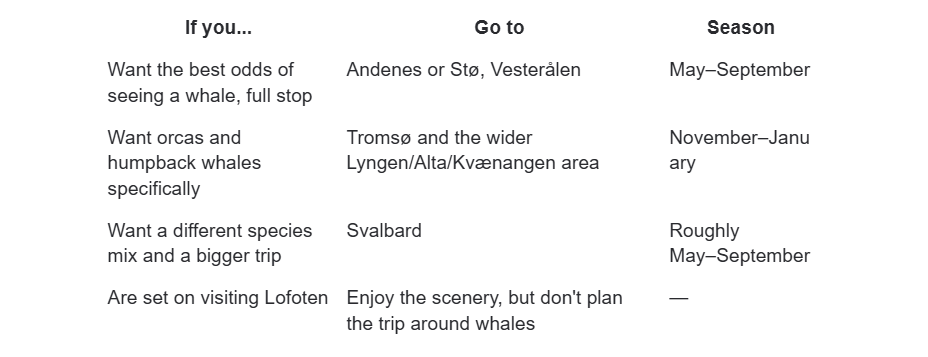
Plan your whale watching trip today
For the mainland safaris, see the Andenes whale safari, Stø whale safari, and Tromsø winter safari pages directly. If you're deciding between Andenes, Stø, and Tromsø specifically, our guide to whale watching regions in Northern Norway goes into more detail on each, and our summer vs. winter guide explains why the two seasons involve such different animals. For what to pack and how far in advance to book, see our travel planning guide.
Frequently asked questions about where to go whale watching in Norway
Where is the best place to see whales in Norway? It depends on your dates and which species you want. Andenes and Stø in Vesterålen are the strongest option for sperm whales, roughly May to September. Tromsø and the surrounding fjords are the winter option for orcas and humpback whales, roughly November to January. Svalbard offers a different species mix further north, in summer.
Can you see whales in Lofoten? Not reliably, and not as a bookable activity. Visit Lofoten's own tourism board says no operators there currently run dedicated whale-watching safaris, and that a sighting is down to chance rather than something you can plan around. Lofoten was actually where Norway's commercial orca-watching industry began in 1985, but it has since moved north to Vesterålen and Tromsø.
What's the best time of year for whale watching in Norway overall? There are two separate windows rather than one. May through September covers sperm whales near Andenes and Stø, and a different species mix in Svalbard. November through January covers orcas and humpback whales around Tromsø. Outside those windows, whale watching becomes considerably less reliable anywhere in Norway.
Should I book a day safari or a multi-day cruise to see whales? That depends on the rest of your trip. Andenes, Stø, and Tromsø are single-day safaris that fit easily into a broader Northern Norway itinerary. Svalbard usually means a bigger commitment — a flight to Longyearbyen and either a guided boat excursion or a multi-day expedition cruise — suited to travelers building a trip specifically around Arctic wildlife.
Do I need to go to Svalbard to see whales in Norway? No. Andenes, Stø, and Tromsø on the mainland cover the two main whale-watching seasons and are far more accessible. Svalbard is worth considering only if you specifically want species that don't appear on the mainland safaris, such as blue whales or beluga, and don't mind a longer, more involved trip to see them.
Join Us on the Water
Whether you're traveling as a couple, family, or solo adventurer— We’re ready to welcome you aboard.

.svg)
.svg)
