
Whale Watching in Norway: Summer vs. Winter Locations
Whale watching in Norway isn't one activity that happens to run in two seasons — it's two genuinely different trips. In summer, sperm whales gather in deep water off Andenes and Stø in Vesterålen. In winter, orcas and humpback whales follow herring into the fjords around Tromsø. Different animals, different behavior, different light, different atmosphere. This article breaks down what actually separates the two seasons, so you can pick based on what you want to see rather than just when you happen to be traveling.
Quick answer:
- Summer (roughly May–September): Andenes and Stø, Vesterålen — mainly sperm whales, which live year-round near the deep Bleik Canyon
- Winter (roughly November–January): Tromsø's fjords — mainly orcas and humpback whales, which follow herring shoals in from the open sea
- These aren't the same trip in different weather: the species, the reason the whales are there, and the daylight are all different
- Arctic Whale Tours has no safari running in February, March, April, or October — those months fall between the two seasons
- The same Whale Pass sighting guarantee (free rebooking, not a refund, if no whales are seen) applies across all three locations and both seasons
Why whale watching splits into two separate seasons
The two seasons exist because of two unrelated biological stories, not because of tour-operator scheduling. Off Andenes, the seabed drops away into the Bleik Canyon, a roughly 50-kilometre submarine trench where depths shift from around 200 metres to over 2,000 metres within a short distance of the coast. That drop-off drives nutrient-rich upwelling that supports deep-water squid, and sperm whales — deep-diving specialists that hunt squid — gather there consistently through the summer months rather than passing through on migration.
In Tromsø's fjords, the story is different: it's about herring, not squid. Each winter, large shoals of herring move in toward the coast to overwinter, and orcas and humpback whales follow them in from the open ocean to feed. Roughly three hours of sailing each way, out of an eight-hour day, goes toward reaching the feeding grounds — so a meaningful part of the trip is travel time to wherever the herring currently are, not just time in the fjords immediately outside Tromsø.
Exactly how far that travel goes is worth understanding, since whale activity itself has shifted over the years. Visit Tromsø, the region's official tourism board, states that whale activity has been concentrated mainly around Skjervøy, roughly two hours north of Tromsø by fast boat, since 2017. That lines up with independent sources: a January 2024 field report on Arctic wildlife trips recommended Skjervøy specifically over Tromsø for the best chance at large numbers of orcas, and a 2025 academic study on Arctic whale-watching tourism describes Tromsø-based operators routinely travelling out to the Skjervøy and Kvænangen fjords, a pattern in place since around 2011, consistent with the whale activity sitting some way out from Tromsø harbour rather than directly on the doorstep.
Summer whale watching: Andenes and Stø (May–September)
Andenes is built around one species: sperm whales, reliably present near the Bleik Canyon throughout the season — one of the most reliable places in the world to see them. Orcas, humpbacks, pilot whales, and various dolphins and porpoises turn up occasionally, but sperm whales are the reason to choose Andenes specifically. The safari runs on MS Alba, a 26-metre catamaran carrying up to 90 guests, daily from May through September.
Stø, further along the Vesterålen coast, casts a wider net: possible sightings include sperm whales, orcas, pilot whales, minke whales, humpbacks, fin whales, white-sided dolphins, and harbour porpoises, alongside seabirds like puffins near Anda Island. The tradeoff for that variety is a smaller boat: the Blasius II, a 22-metre catamaran, runs June through July, switching to the RS 78 Hagbart Waage (a former Norwegian rescue vessel) in August, with a maximum of 60 guests. Stø's season also runs June 1 to August 31 — a month shorter than Andenes's May-to-September window.
Both summer locations sit inside or near the midnight sun period for this part of Norway (roughly late May to late July), so early- and late-season bookings will see a normal sunset while a safari in the middle of summer runs in round-the-clock daylight.
Winter whale watching: Tromsø (November–January)
Tromsø's safari targets orcas and humpback whales, feeding, diving, and sometimes breaching as they work through herring shoals, with fin whales, dolphins, or porpoises occasionally also seen. The season runs November through January and departs on a vessel also named MS Alba — up to 90 passengers, a minimum of 20 required to run — heading out from Tromsø harbour into "the soft twilight of the polar day," as we put it, for roughly eight hours round trip.
That phrase is a reasonable description of what winter light actually looks like this far north: this is the polar night period, so instead of full daylight you're working with a long, low, blue-toned twilight rather than darkness the entire time. The minimum age is one year, with children under 16 required to be accompanied by an adult, and the boat isn't equipped for strollers or wheelchairs.
Andenes and Tromsø, side by side
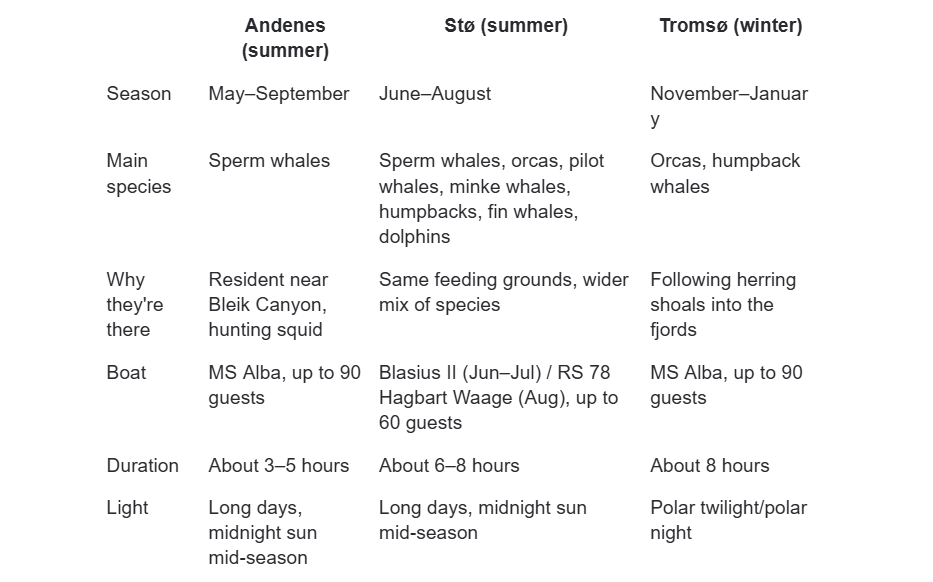
So which season should you actually choose?
- Want the best odds of seeing sperm whales specifically: Andenes, summer
- Want the broadest mix of species in one trip: Stø, summer
- Want orcas and humpbacks, and don't mind cold and short daylight: Tromsø, winter
- Want long days and warmer conditions on deck: either summer location
- Traveling in February, March, April, or October: none of our safaris run in these months — you'd need to shift your dates into one of the two active seasons
Neither season is objectively "better" for actually seeing a whale — sightings are likely in both, though we don't publish an independently verified sighting-success percentage for either season. The real decision is which species and which atmosphere you're after.
Beyond Andenes, Stø, and Tromsø: the wider Norwegian picture
Both seasonal patterns extend beyond these three specific harbours. The winter herring migration that brings orcas and humpbacks to Tromsø also plays out further along the coast — Visit Norway groups Tromsø together with the Lyngenfjord, Alta, and Kvænangen areas as part of the same mid-winter phenomenon, since the herring (and the whales) don't stay in one fixed spot from year to year. And sperm whales aren't the only reason to go north in summer: Svalbard, considerably further north again, has its own summer whale-watching season (roughly May–September) built around a different mix of species — blue whales, minke whales, and beluga among them — typically visited on multi-day expedition cruises rather than a single-day safari. If you're researching Norway's whale watching broadly rather than one specific operator, it's worth knowing the Andenes/Stø/Tromsø pattern is part of a larger coastal picture, not the whole of it.
The same guarantee applies in both seasons
Regardless of which location or season you book, Arctic Whale Tours' Whale Pass guarantee applies: if no whales or dolphins are sighted on your safari, you're eligible for one free rebooking on another available safari within the same or following season, for the same participants, subject to availability. It's a rebooking, not a refund — see our full breakdown of the Whale Pass guarantee for exactly how it works and how it differs from the separate weather-cancellation policy.
For the full details on each safari, see the Andenes whale safari, Stø whale safari, and Tromsø winter whale safari pages, or read our travel planning guide for what to pack for either season. If you're still weighing locations more broadly, our guide to where to go whale watching in Northern Norway covers all three in more depth.
Frequently asked questions about summer vs. winter whale watching in Norway
Is whale watching in Norway a summer or winter activity? Both — Arctic Whale Tours runs summer safaris (roughly May–September) from Andenes and Stø, and a separate winter safari (roughly November–January) from Tromsø. They target different whale species in different locations.
What's the difference between the whales seen in summer vs. winter? Summer safaris mainly see sperm whales, which live near Andenes year-round due to the deep Bleik Canyon. Winter safaris in Tromsø mainly see orcas and humpback whales, which migrate into the fjords to follow herring shoals.
Can you go whale watching in Norway all year round? Not continuously with Arctic Whale Tours. There's a gap between seasons: nothing runs in February, March, April, or October. The summer season covers May through September and the winter season covers November through January.
Is winter or summer better for whale watching in Norway? Neither is clearly better — they're different experiences with different species. Summer offers milder weather, longer days, and reliable sperm whale sightings; winter offers orcas and humpbacks, colder conditions, and polar twilight instead of full daylight.
Do the same boats run in summer and winter? Not the same fleet across the board. Stø uses the Blasius II from June through July, switching to the RS 78 Hagbart Waage in August. Andenes and Tromsø are each served by a vessel named MS Alba, running in their respective non-overlapping seasons.
Are there other places in Norway to see whales besides Andenes, Stø, and Tromsø? Yes. The same winter herring migration that brings orcas and humpbacks to Tromsø also affects the wider Lyngenfjord, Alta, and Kvænangen area further north. Separately, Svalbard has its own summer whale-watching season with a different species mix — including blue whales, minke whales, and beluga — typically visited by expedition cruise rather than a single-day safari.
Join Us on the Water
Whether you're traveling as a couple, family, or solo adventurer— We’re ready to welcome you aboard.

.svg)
.svg)
